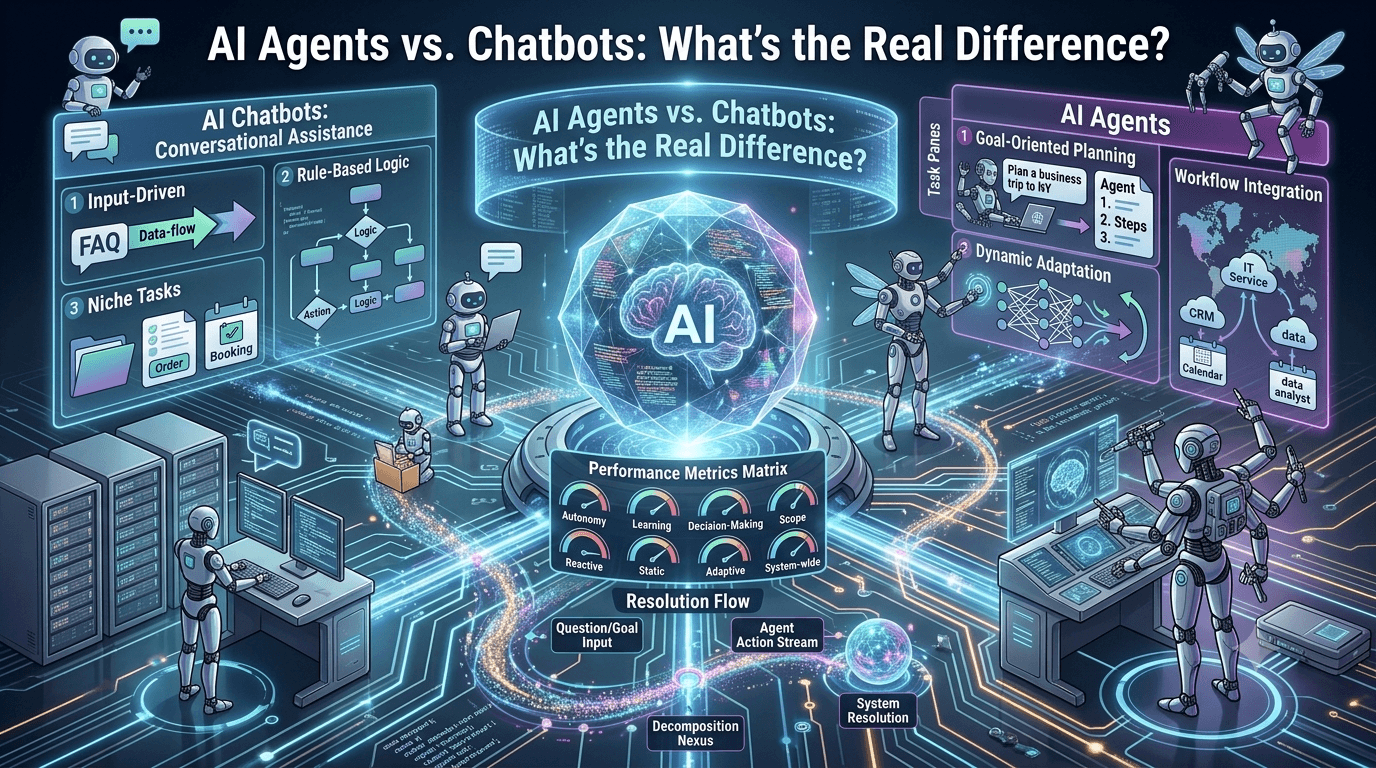
AI Agents vs. Chatbots: What's the Real Difference?
Artificial Intelligence has become a buzzword in almost every industry. Businesses are investing in AI to improve customer service, streamline operations, and reduce repetitive work. In the middle of this transformation, two terms are often used interchangeably: AI Chatbots and AI Agents.
Although both are powered by artificial intelligence, they are not the same.
Many companies believe that installing a chatbot means they have implemented AI automation. In reality, a chatbot is only one piece of the puzzle. AI Agents represent the next generation of intelligent automation, capable of not only communicating with users but also reasoning, making decisions, and completing complex business tasks.
Understanding this difference is essential for any business planning to invest in AI. Choosing the right solution can improve customer experience, save hundreds of work hours, and create more efficient business processes.
Let's explore what sets AI Agents apart from traditional chatbots and why businesses are increasingly moving toward autonomous AI systems.
What Is an AI Chatbot?
An AI chatbot is a conversational application designed to interact with users through text or voice. Its primary role is to answer questions, provide information, or guide users through predefined processes.
Modern chatbots have become much smarter thanks to Large Language Models (LLMs), but their core purpose remains the same: conversation.
A chatbot is excellent at tasks such as:
For many businesses, chatbots provide a fast and cost-effective way to improve customer service while reducing the workload on support teams.
However, even advanced chatbots have limitations.
Most stop after the conversation ends. They may tell customers what to do, but they rarely perform the work themselves.
What Is an AI Agent?
An AI Agent goes far beyond conversation.
Instead of simply responding to questions, an AI Agent is designed to achieve a goal.
It can understand objectives, create a plan, gather information from multiple sources, make decisions, use different software tools, and complete tasks with minimal human involvement.
Think of it as hiring a highly efficient digital team member.
Rather than saying,
"Here is how you can solve your problem,"
an AI Agent says,
"I've already solved it for you."
For example, if a customer requests a refund, an AI Agent can:
All of these actions can happen automatically within seconds.
This ability to combine reasoning with execution is what makes AI Agents fundamentally different.
The Biggest Difference: Conversation vs. Action
The easiest way to understand the distinction is this:
Chatbots talk. AI Agents act.
A chatbot focuses on providing information.
An AI Agent focuses on completing work.
Imagine asking both systems the same question:
Customer: "Can I reschedule my appointment?"
A chatbot might respond:
"Yes. Please visit this page or contact our support team."
An AI Agent would instead:
The user experiences a completed task rather than a simple conversation.
How Businesses Use Chatbots
Chatbots remain valuable because they solve many customer communication challenges.
Common business applications include:
Customer Support
Answering common questions around the clock.
Lead Generation
Collecting visitor information and qualifying potential customers.
Appointment Booking
Helping customers reserve meetings or consultations.
Product Recommendations
Suggesting products based on customer preferences.
Internal Help Desk
Helping employees find company policies or IT resources.
These are all useful applications, but they generally focus on communication.
How Businesses Use AI Agents
AI Agents are designed for end-to-end automation.
Examples include:
Sales Automation
An AI Agent can identify new leads, research each company, personalize outreach emails, update the CRM, schedule meetings, and notify the sales team when prospects are ready to buy.
Customer Service
Instead of simply answering questions, an AI Agent can process returns, issue refunds, create support tickets, update customer records, and follow up automatically.
Human Resources
AI Agents can screen resumes, schedule interviews, answer candidate questions, prepare offer letters, and onboard new employees.
Finance
Finance teams use AI Agents to the process invoices, reconcile transactions, identify unusual expenses, and prepare financial reports.
Marketing
Marketing departments can automate campaign reporting, content planning, competitor research, email segmentation, and performance analysis.
Instead of automating individual tasks, AI Agents automate entire business workflows.
Can AI Agents Work with Chatbots?
Absolutely.
In fact, this is becoming the preferred approach.
The chatbot serves as the communication interface.
The AI Agent works behind the scenes.
For example:
A customer opens your website and asks,
"Where is my order?"
The chatbot receives the question.
The AI Agent then:
To the customer, the interaction feels like chatting with one intelligent assistant.
Behind the scenes, multiple automated processes are taking place.
Why Businesses Are Moving Toward AI Agents
Today's organizations use dozens of software applications.
Customer information lives inside CRMs.
Invoices are stored in accounting systems.
Documents sit in cloud storage.
Support requests arrive by email.
Traditional chatbots cannot coordinate all these systems effectively.
AI Agents can.
They connect different applications, retrieve information, make decisions, and perform actions without requiring employees to switch between multiple platforms.
This saves time, reduces human error, and improves operational efficiency.
Are Chatbots Becoming Obsolete?
Not at all.
Chatbots still play an important role in customer interaction.
However, businesses are increasingly enhancing chatbots with AI Agents.
Think of a chatbot as the receptionist.
Think of an AI Agent as the operations manager.
The receptionist answers questions.
The operations manager gets things done.
Together, they create a seamless customer experience.
Which One Should Your Business Choose?
The answer depends on your business goals.
A chatbot may be sufficient if you need to:
An AI Agent is the better choice if you want to:
Many organizations ultimately benefit from combining both technologies.
The Future of Business Automation
Artificial Intelligence is evolving rapidly.
Businesses are moving beyond simple conversations toward intelligent systems that can plan, reason, and execute work independently.
AI Agents are leading this transformation.
They don't replace people—they remove repetitive work so employees can focus on creativity, strategy, and building stronger customer relationships.
Companies that adopt AI Agents today will be better prepared for tomorrow's competitive landscape.
The question is no longer whether AI will transform business operations.
The question is how quickly your organization will embrace that transformation.
Final Thoughts
Chatbots introduced businesses to conversational AI, making customer interactions faster and more accessible. AI Agents build on that foundation by adding intelligence, decision-making, and real-world action.
If your goal is simply to answer questions, a chatbot may be enough. But if you want to automate workflows, improve productivity, and create truly intelligent business operations, AI Agents offer a much greater opportunity.
As organizations continue their digital transformation, the future belongs to businesses that combine human expertise with AI-powered automation. The most successful companies won't choose between chatbots and AI Agents—they'll use both together to deliver exceptional customer experiences and smarter, more efficient operations.
Ready to automate your business?
Book a free discovery call and let's map out your first automation.
Book Free Call